エーフィック|Aphic
After Walker Evans 2
作品解説
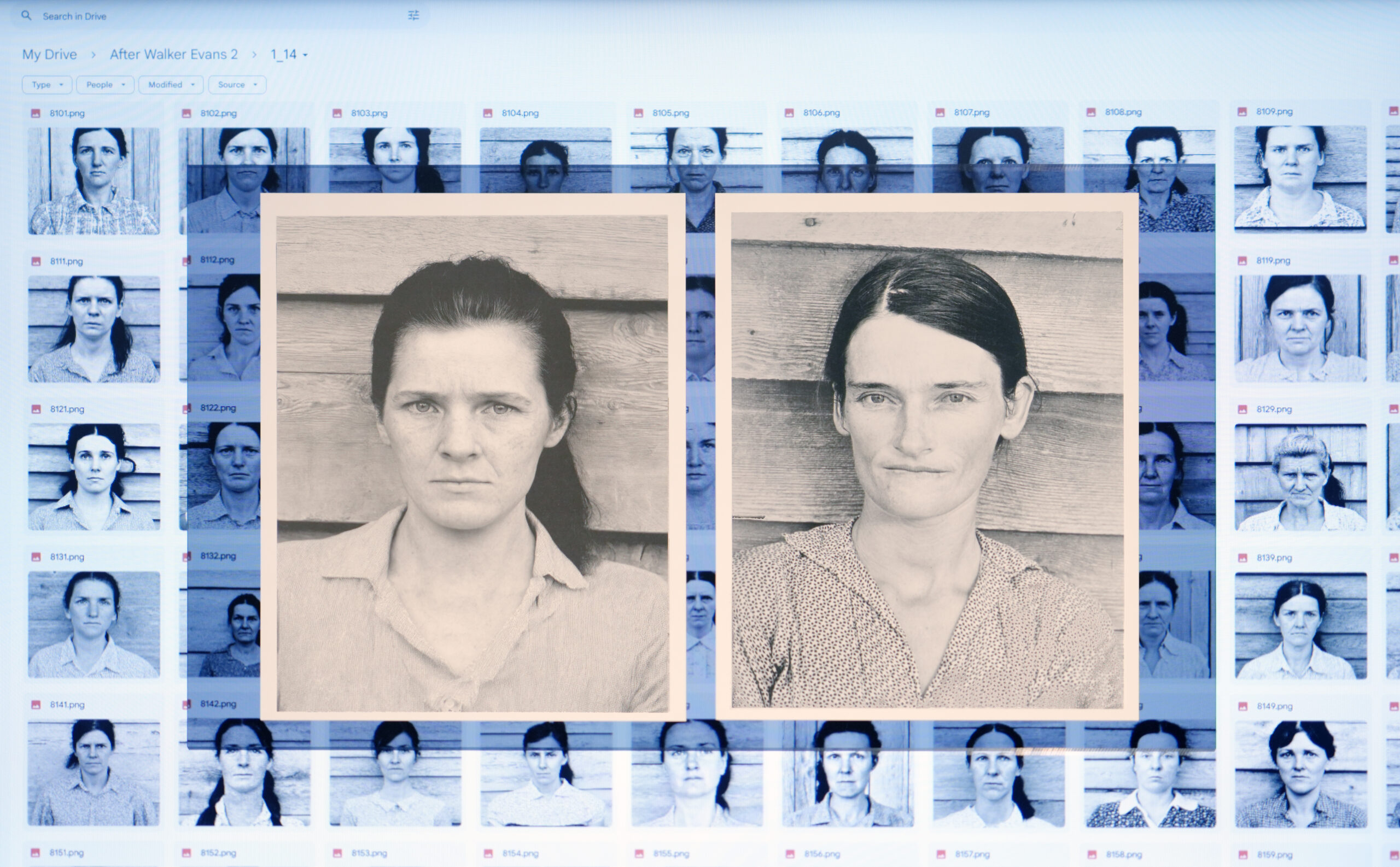
古い時代に撮られた女性のポートレイト。実はこの二枚のイメージのうち、左はカメラで撮影されたものではなく、膨大な画像を学習したAIによって生成されたものだ。撮影された写真とAI画像は、いまや簡単には見分けられない精度にまで近づきつつある。
出発点となったのは、右の写真を撮影したアメリカの写真家ウォーカー・エヴァンスが、1938年に発表した名作写真集『American Photographs』。エヴァンスは当時の人々の暮らしや街の風景を克明にとらえ、写真によって目の前の現実を記録することを追求した。それから43年後の1981年、アメリカのアーティスト、シェリー・レヴィーンは、エヴァンスの写真を複写した《After Walker Evans》を発表。他者の作品を自らの作品として提示するアプロプリエイションの手法で、「誰が作者なのか」「オリジナルとは何か」を問うた。
さらにその43年後、AphicがAI画像生成ツールのStable Diffusionを用いて制作したのが、このエヴァンスの写真に“似た”画像だ。一万枚を超える生成画像の中から、元の写真に近いものを作家たちの手で選び出すことで生まれた作品。撮影する、複製する、AIに生成させる。本作は、三つの異なる方法をたどることで、時代ごとの社会と写真の関係を探る。そして、写真らしさ、AIらしさが何によって生まれるのかを問い直すのだ。
Before us are two portraits of women side by side: the left an AI-generated likeness of a woman from another era, made without any camera; the right a photograph by Walker Evans. Together they show how machine-made realism unsettles the line between what is photographed and what is inferred.
The point of departure is Walker Evans’s American Photographs (1938), a pursuit of unadorned documentary clarity. Forty-three years later, Sherrie Levine’s After Walker Evans (1981) rephotographed his images, using appropriation to question authorship and the idea of the original. Another forty-three years on, Aphic employs Stable Diffusion to generate images “resembling” Evans’s, selecting from more than ten thousand outputs those closest to the originals.
Moving from photographing to rephotographing to AI inference, the work traces how each era’s social and technological conditions reshape photography’s relationship to its moment, asking what makes an image legible as photographic or AI-generated—and how those categories may shift within the horizon ahead.
Profile
エーフィック|Aphic
2022年に三井所高成と佐藤史崇によって結成されたアーティストユニット。写真表現を基軸に、都市と地方、過去と現在など、離れた点と点を一定の規則のもとに整列することで作品を構成する。並べられた点は線となり、その先へ導く矢印を浮かび上がらせる。代表作『北北東へのトレイル』 (2022年) では、東京の展示会場と福島第一原子力発電所を結ぶ直線上の等間隔な地点において、風景と放射線の飛跡を重ね合わせて記録。アルゴリズムに依拠した厳密な手法によって目には見えない放射線の風景を可視化することで、非日常と思われがちな原発や放射線が、私たちの日常と地続きに存在していることを提示している。
Founded in 2022 by Takanari Miisho and Fumitaka Sato, the collective works through photographic systems to align distant points—urban and rural, past and present—according to strict rules, revealing hidden trajectories. In Trail to the NorthNortheast (2022), they record landscapes and radiation along a straight line from Tokyo to Fukushima, visualizing an unseen continuum between daily life and the nuclear site.